Invisiblock
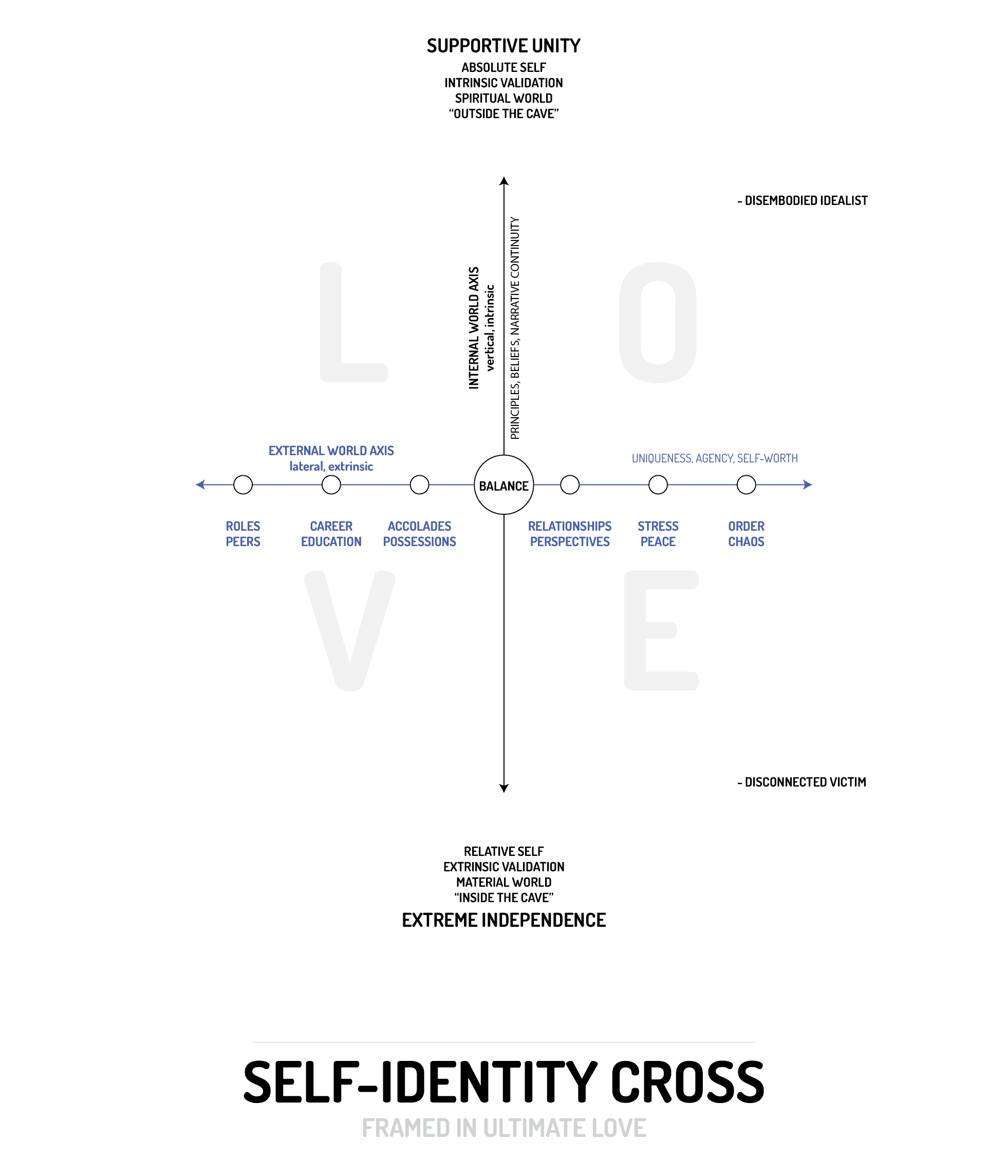
In the middle is the “balance” spot, where most people should aim to be. Extending vertically outward is the internal world axis, and the external world axis draws itself horizontally.
Notice that in the background is the ultimate environment of love to support and accept all activities.
Axes
The vertical axis represents the Inner World. The uppermost region of the axis is toward a supportive unity with all within existence. It’s a communal feeling of mutual respect for Equal-but-different individuals. It’s driven by internal validation, and it symbolizes the ideal, or Absolute Self.
The lowermost region is characteristic of extreme individualism that is driven by external validation. This is a victimhood, or a me-versus-the-world, perspective. Here we see the impulsive or relative self.
This represents the Shared Reality. Instead of having two ends of the axis, it has several points along it. Those points are defined as your roles (sibling, mother, employee, etc.) and your peers (friends, colleagues, family, etc.). It also represents interactions with the world, such as consequences, events, and activities.
When there are many connection points, sometimes those points fight against each other or your own principles. This can result in the feeling of being pulled in many directions at once.
If you are entirely based in the external world, you give control over your validation to the people around you and the events in your life. You may be an ego-driven person, and you may have a narrow perspective on the world. You value merit, recognition, and competition. You get validation from material rewards, such as praise, reputation, or possessions.
In the program, this is a lateral movement because it symbolizes interactions with events and otherwise equal-but-different people. It’s a feature of the “relative self”.
Balance the Axes
The task of balancing the two ends of the internal world axis and the various points along the external world axis is complex. The idea is to try to maintain a strong sense of internal validation while also making and maintaining connections with what it means to be a human in this life right now.
Disembodied Idealist You may believe that you feel bigger than a human, like you are a spirit. You may feel a disconnection with the world because it’s cruel and nonsensical at times. You may feel above it all and unable to find an identity in the external world.
Disconnected Victim You may believe that the world is actually hostile to you. It may seem like no one cares, you are on your own, and there is no safety. You might feel that you are incapable of being strong enough for your own good, and the energy for even maintaining your internal world is dwindling.
Info
You can believe whatever you want, but allowing your belief to disconnect you from reality is harmful.
Idealist or victim, these are the extremes of life. Survival depends on your ability to navigate the external world while maintaining the internal one. They depend on each other, which is why you must strive for balance.
See Also
Link to Validation
Self-identity Cross
If you are firmly based in the outer environment, you give control over your validation to things outside of yourself, such as people, reputation, possessions, or other worldly things. You may not feel a strong connection to the work you do, but the rewards and attention that you get. Your perspective on the world may be narrowly focused on achieving influential goals. You might be totally ignoring the inner environment.
In this program, this is illustrated as a horizontal movement, an expansion or shrinkage within the outer world. It’s a feature of the “relative self”.
Link to Validation
Self-identity Cross
If you are firmly based in the inner environment, you give control over your validation to yourself. By doing so, you rely on the deep, personal connection to your “soul”, or your core being on an existential level. You may feel deep, meaningful connections with your purpose in life, people, and places. You may have a very wide perspective on the external world.
In this program, this is illustrated as a vertical movement, a transcendence above the outer world or an immanence with it. It’s a feature of the “absolute self”.