Self-identity Path
Modules > Love > Instinct > Self-aware > You are here
Cleanembed
In this program, self-identity means a person’s uniqueness, principles, beliefs, agency, self-worth, and narrative continuity. These are known as the strings of our “six-string guitar” metaphor.
Link to original
Self-identity is established by asking establishing the ultimate environment of love. Then, we seek to “know thyself” as we ask existential questions and answer them.
Everything about a person is irreplaceable. A person has their own body, personality, background, values, and more. They embody a perspective that is entirely their own. Self a way to know oneself so as to proceed by making choices that align with who they are.
Cleanembed
Moral
Link to original
You can’t love others if you don’t love yourself.
Cleanembed
Link to originalInvisiblock
Mnemonic
- You are never separated from love.
- A defenseless port invites pirates.
Cleanembed
Link to originalInvisiblock
Illustrative Story
Goal
Cleanembed
Link to originalInvisiblock
Know yourself more so that you make better choices.
- You will know what the self wants, its worth, its principles, its uniqueness, that its actions matter, and that its current beliefs are filtered away from indoctrination and toward intuition.
- You will know what you prefer by feeling what’s right (alignment, resonance) and what feels wrong (misalignment, dissonance) through intuition.
Cleanembed
Link to originalInvisiblock
CONSIDERATIONS
- The self is as special as every other because it’s not a competition of uniqueness but a celebration of variety.
- You are as special as a potato in a basket of potatoes. You might have a special shape, have a fuller flavor, and be a bit more robust, but you are a single potato among many.
- In this process of defining self-identity, there is no judgment, and there isn’t a plea for validation. We’re just being aware that you are unique.
Learning Points
These are the focus of this lesson. Just under the questions are the Misery Points, what you might feel if you haven’t answered these questions.
-
Where am I?
- Anxiety
- Disorientation
- Inflated Ego
- Disconnected
- Loneliness
- Unsupported
-
Who am I?
- Compliant
- Unprincipled
- Easily Manipulated
- Helplessness
- Worthlessness
- Meaninglessness
- Performative Relationships
-
What do I want?
- Resentment
- Apathy
- Envy
- Chronic Burnout
- Existential Drift
1. Where am I?
- it orients by:
- humbling the ego and inducing a sense of awe;
- defining the rules of the “game” you’re playing;
- offering love as the ultimate environment.
- it reveals the environment by:
- moving it away from a cold space toward a warm place, giving context, texture, and color. It’s not just a place on a map, but it’s a living experience.
- transitioning a person from a passive observer to an active participant of the world.
- You aren’t watching your life happen on a movie screen. You are the character making decisions and taking actions.
- it distinguishes ego from soul by:
- showing that the ego is a mortal part of you that lasts as long as you are alive, which can be equated to subjectivity;
- explaining that the world’s idea of “soul” is an immortal part of you that lasts forever, which can be equated to objectivity.
1.1 Scale
It’s important to know where you are before you begin your journey. In this section, you take a look around existence as we know it. You understand your location and your relationship to your Environments.
Cleanembed
Link to originalInvisiblock
Our universe is both vast and tiny, wide and narrow, shallow and deep. You will be thrilled at how big you can be and amazed at how small you are.
When you click the Scale of the Universe 2 by Cary Huang below, you will see an interactive scale of the universe. At the bottom of the screen, there is a scrollbar. Dragging the circle left goes deeper into the micro (small) universe. You’ll see things like rice and a grain of salt. Dragging the circle right goes deeper into the macro (big) universe, where you’ll see stars and galaxies. You are encouraged to go left first, then go right.
- Scale of the Universe 2
- How do you feel after seeing that?
- Do you feel big, small, or free?
1.2 Understanding Environment
Cleanembed
Link to originalInvisiblock
Environments are what are inside of us and around us. They help shape our world both inside and outside of us.
Science informs us that an organism or an object can never be removed from the environment. No matter where it is, it exists within some kind of environment, whether that’s an ocean or the surface of a distant moon.
In this program, environment is understood in these ways.
Order of Environments
- Love
- Inner World
- Personal Boundaries
- Shared Reality
Cleanembed
Link to originalInvisiblock
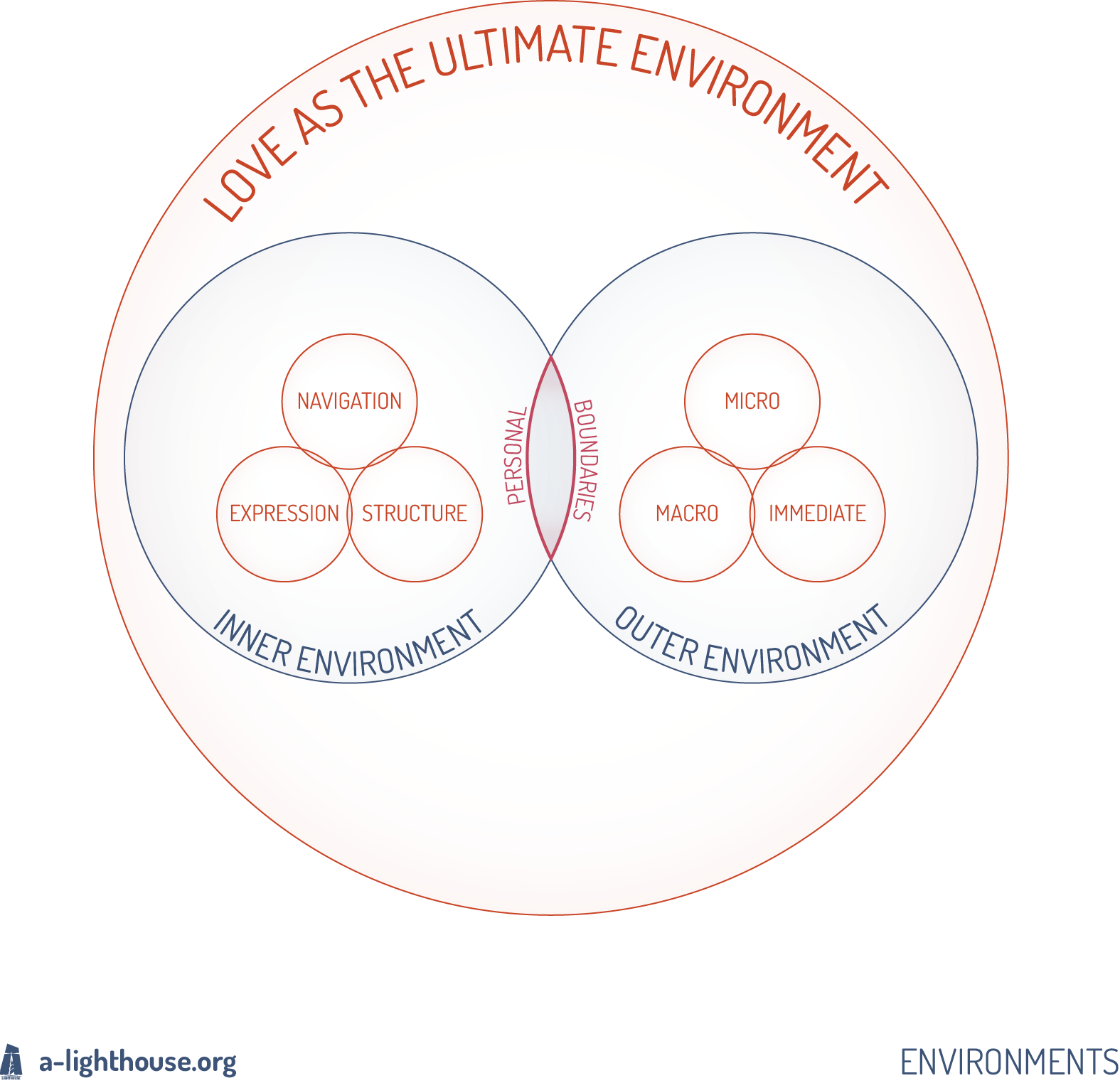
Love as the Ultimate Environment
Inner Environment
Link to originalSummary
This inner world is shaped by your mind, which is the collection of your thoughts and emotions. It changes through willpower, experience, and education, and it can be influenced by your physical body and environment.
It’s a private world only you can sense, and it’s used to help you interact with and understand yourself. It helps you interpret the outer world so that you can survive it.
Think of the inner world as a chaotic dream. While logic is like a detective peering in and trying to make sense of it all, it can’t feel it. The logic interpreting the chaos can structure the dream by organizing it, but it could also be flawed and totally wrong. Therefore, you can use logic to detect patterns, but don’t entirely disconnect from emotions to do so.
Personal boundaries are what protect the inner environment from the outer environment. That is coming up in the Self-love section of the program. It’s in development!
Outer Environment
Link to originalSummary
This is the world you inhabit together with other people, objects, and places—from vast galaxies to small atoms. It is the outer landscape of physical facts, places, and events that multiple observers can experience.
This is shaped by time, space, and physics, and it is constantly changed by the Feedback Loop.
The shared reality is both the classroom and the teacher, but it is neutral to your success: it neither favors nor despises anyone. However, the systems behind it retain nearly full control of what happens to you physically and, in some cases, mentally.
BREAKOUT!
1.3 Conclusion
You are never separated from love, even if you feel that you are. You cannot see the air, yet it’s there. Love knows and supports you, but it pushes you to grow in ways that unite rather than divide. When the time for survival mode reaches its end, love is ready and waiting to receive you.
We have separated the environments in your life so that we establish how you fit into the scale of the universe. This breaks things into smaller, manageable pieces, and it’s okay to feel small or big at times. Consider this: there are many big or small things you could be worrying about, but you aren’t, yet life continues.
Activities
- Scale of the Universe: See how big or small you are compared to the universe
Micro Actions
- Three Breaths, One Universe: Ground yourself in anxious moments
2. Who am I?
- It reveals your uniqueness, not through vanity or humility, but as a service to love.
- It reveals your principles.
- It helps you know what to believe by trading indoctrination for intuition.
- It shows that your actions matter.
- It shows how to value yourself.
- It shows your identity across your life.
- It helps you know what you want and set goals.
- It unveils your locus of control (how you seek validation) by distinguishing the relative self from the absolute self.
- You may wish you see more in Realistic Confidence.
2.1 Validation
Cleanembed
In the context of human existence, this is the need for you to be seen, heard, and acknowledged as a valuable person. Validation is how you find value in yourself. It reassures you that your internal world and private reality (your thoughts, feelings, and existence) matters and is sensible. It gives a sense of belonging to the world and in your human body.
Link to original
A person stands between an internal and external world. We can picture these relationships by looking at an illustration called the Self-identity Diagram.
BREAKOUT!
For Youngsters and the Sheltered
If you are a young person, knowing who you are can start any time you are ready to ask these questions.
Whether you are young or you don’t have much experience with life, existence can become a drag. That’s because you have grown comfortable with the status quo; you’ve hit a happy medium. When you start thinking of getting out there in life, you remember the pain it causes. This is the Emotional Avoidance Trap in effect!
Therefore, you avoid activity because it feels like moving is dangerous, but this mindset is like being in quicksand. If you don’t move, eventually you will just sink.
The existential questions asked regarding self-identity are heavy. Sometimes, the reality is that it takes time and experiences to discover the answers for yourself. Before your self-identity is realized, it’s a good idea to involve yourself in various activities.
You don’t have to know who you are before you interact with the world. Thinking tirelessly of who you are can be an endless loop if you have no understanding on what’s possible in the world.
Therefore, experience the world, set a goal, and explore. Toss some ideas against the wall and see what sticks. Try stuff you never tried before. Travel to a new culture if you can. Doing so can open up many new perspectives and give you great clues as to what you prefer, which may lead to refining and revealing who you are.
No matter what you do, the experiences you have will teach you something. The more experiences you have, the better the chance you will find something meaningful to you.
2.2 Six-String Guitar
In the program, your self-identity is composed of 6 important aspects, and we use a six-string guitar to illustrate the understanding of how these aspects work together. Each of the below aspects, or strings, are explained later.
Cleanembed
Link to originalSix-Strings Metaphor
- Structure
- Principles
- Beliefs
- Narrative Continuity
- Expression
- Uniqueness
- Agency
- Self-Worth
Think of an acoustic guitar and all its parts that make the instrument special and valuable. The six parts of “Who am I” are like strings on that guitar. We’ll also give them a special counterpart piece of the guitar’s anatomy.
Breakout!
Locus of Control
Remember, the locus of control describes how you seek validation, from the external or internal world. It’s called the locus of “control” because it gives control over your mental state to the internal world (you) or the external worlds (other people and events).
How to Find Your Locus of Control
Finding what validates you is important because validation gives us the energy to keep going. Think about moving through a room, but no one looks at or engages you. Depending on your locus of control, you could feel fine or like a ghost.
Cleanembed
Link to original
Feature Relative Self Absolute Self Primary Question ”Where do I stand?" "What is true?” Source of Worth External validation and competition Internal alignment and existence State of Mind Anxiety, scarcity, and separation Peace, abundance, and unity Perspective Looking at the world from a localized ego Looking with the world as an interconnected whole
You can use this chart to see what makes you feel validated. Write it down so that it’s easier to remember. Most people will feel a mixture of both internal and external validation, but try to choose the dominate one.
Click Absolute vs. Relative Self if you want to know more about this.
2.3 Conclusion
You are a vast, complex, and almost undefinable human being, but just like any other subject, you are knowable. There are so many aspects to who you are; it might be impossible to know all of them, but you can at least try to know some. The fact is the more you know yourself, the more you understand yourself, and the easier you can give yourself the gift of your personal power.
You matter because we need you, only most of us don’t know it.
Activities
- Bumpy Key: A demonstration of your uniqueness
- Belief, Flaw, Purpose: A brief glimpse into who you are
- Robot Copy: What if you were replaced by a robot copy of yourself?
Micro Actions
- One Leaf, One Tree: A helpful, 30-second micro action that defines who you are
3. What do I want?
- It reveals what you truly want and encourages to realize your dream, not the social one.
- It teaches that true desire is active, creative, and full of challenges.
- It shows the difference between escapism and productivity.
- It uncovers the traps that will slow your pace and the states that define it.
3.1 Desire
If you understand what desire is, it becomes easier to find it.
Definition of Desire
Link to originalInvisiblock
A desire is a deep-seated want associated with you; it’s not a casual impulse. It’s when the self seeks to express its inner world in the external world. It’s your identity assessing your immediate, external environment and deciding how it wants to contribute.
Many people think that wanting something is a fun exercise, but actually, it is full of pain because there are usually challenges to overcome.
When you declare a deep desire, the three Desire Pains become immediately clear to your subconscious mind.
Cleanembed
Link to originalDesire Pains
With every desire comes an alert of what it takes to accomplish it.
Threat of FailureYou might try and fail, then be forced to face your weaknesses.
Gap PainYou feel the acute sting of having to work to close the skill or effort gap.
Threat of VulnerabilityYou admit to yourself and the world that you care enough about something to risk being ridiculed, which may break your heart.
Traps and States
What happens next? Either you are strong enough to know and accept the risks, or you fall into Traps or States, for better or worse.
3.2 Conclusion
Learning what you desire is the third step. You first must learn how to desire. To learn how to desire, you must do one of two things (both at the same time is good): experience the world by taking agency and by knowing who you are so that you can gift yourself with something appropriate.
It’s like buying a gift for someone that you don’t know: you don’t know where to start, so you go the safe route and buy something practical. This is safe, but it doesn’t always work.
Activities
- Desire Formula: How to find your desires
Micro Actions
- Thresh the Husk, Take the Grain: Shed your old habits to find your desires
Conclusion
By now, you may see a pattern developing: be human, be you, and involve yourself in the world. Everyone has their own reality; they wish for it to be real, but reality only reflects what happens, not dreams. When we try, we are met with friction: the stress of effort, the sting of failure, and the drain of disappointment. We see those as mistakes that set us back, but they are the steps that teach. We learn what is best for us, what doesn’t fit us, and we grow from that.
Human Tree Analogy
Link to originalInvisiblock
You are constantly growing, and you are never set back. Think of yourself as a sapling growing into a tree. You grow and reach for the sky, and you make good progress. You develop a solid trunk, and now you have a few leafy branches. Yet, your newest branch extends into the shadow of a neighbor tree, and it receives less sunlight there. As a result, it dies and falls off. As a result, you extend your new branch in a different direction, and this time it grows into the sunlight. You develop into a large tree that lives for decades yet.
Looking at this analogy in the light of a human experience, you may think the tree made a mistake by growing in the direction of a shadow. You might not, too. The limb that fell off is like you being rejected, experiencing failure, or reaching somewhere that isn’t actually fit for you. You will have emotions over that, which is normal, but you will grow again. What you experienced is the same thing a tree experiences, and maybe trees have emotions. The important part is that they continue to try, and you can, too.