Invisiblock
The Observer Observing the Observed (OOO) Effect is a simple way to understand how your attention changes your life. It brings together scientific findings from psychology and physics to reveal a powerful truth: your awareness transforms your experience and reveals your personal power.
It uses the Observer Effects in psychology and quantum physics, along with the Meta-awareness & Spotlight Theory, to blend together as an example of noticing your own mental states. This is an illustration of how ignoring emotions amplifies suffering, while focusing emotions diminishes suffering.
Announote
We reference information from Observer Effects below.
How do you change behavior?
How do you break the cycle of always reacting to things emotionally? You do this by observing your thoughts.
Cloud Watching
Link to originalInvisiblock
Imagine yourself lying down in a nice, grassy meadow on a cool day. You are comfortably clouds in the sky as they float by. You might see that a particular cloud looks similar to something you know, a turtle, a duck, or a horse. As the cloud floats along, it loses that shape before it fades away completely. You may not have emotional reactions when you see such symbols in the sky; they’re passive observations. You have no attachments to the clouds themselves.
Now, imagine that the “you” lying in the meadow is The Witness, your Observation Deck of how you observe yourself and interpret environments. Imagine next that the clouds are your thoughts and emotions. In this way, you sort of detach your emotional brain and go into a passive, objective perspective. By doing this, you are enabled to see your emotions as temporary states. You can choose to focus on them and be emotional, or you can choose to understand them and be logical. Both choices are useful in their own time. You must feel emotions to understand them, then progress to logic.
Explanation
The above example of cloud watching is an easy way to think about Metacognition, Meta-awareness, & the Spotlight Theory of Attention (pioneered by Michael Posner, cognitive psychologist).
In quantum physics, it’s claimed that something becomes more defined when it is observed. In psychology, it’s claimed that the emotions you ignore remain and compound your health, while the emotions you focus dissipate and relieve your health. We use metacognition to think about how we are thinking. We use meta-awareness to be aware of emotions. The OOO Effect combines all of these into a model that demonstrates your agency of choosing emotions or logic.
First, when you look at your emotions and thoughts without judgment, you step out of the Emotional Avoidance Trap and into being an objective observer. You realize that the anxiety isn’t fully you; it’s only a moment.
Second, when you create a pause between a situation and your response, your agency has a chance to step in. You stop reacting automatically and start acting intentionally.
Third, by focusing each pain without denial, you expand it so that you can accept it and overcome it. Your Inner World becomes less divided and more unified. Pains are no longer things to suppress, but stepping stones to your personal power.
Finally, everything expands so large and you process everything so well that the compartmentalized suffering transforms into an atmosphere of support, all within the the ultimate environment of love. You stop fighting the world, and you join with it. Every experience, whether it is good or bad, pleasing or painful, is not a mistake or misstep. They are the experiences you need to expand your personal growth and be an active agent of your own life.
Cleanembed
Link to originalInvisiblock
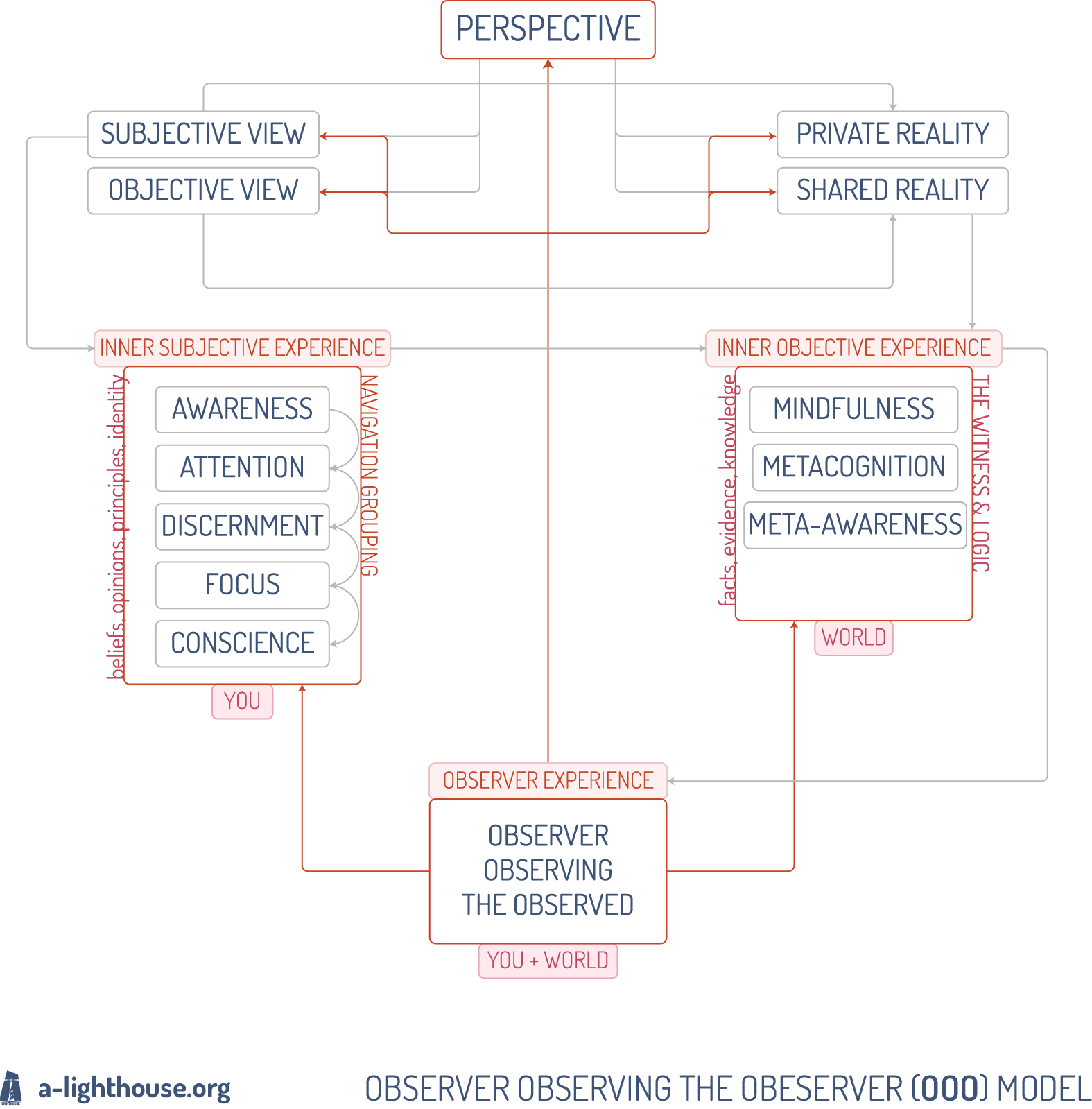
OOO Walkthrough
Imagine standing in a pitch-black room. The darkness represents a lack of consciousness.
Now, let’s say that a dim light has been switched on, and it fills the room with a soft glow. You passively notice the shapes of objects, but nothing stands out. This ambient lighting represents your Awareness, the background state of being present. This connects to The Witness in the Faculty.
Suddenly, you notice a faint, orangish light that you didn’t see before. Your eyes snap to it, and you pay close Attention to it. This is an automatic decision based on survival because your brain is attracted to movement and light, which connects to Instinct. Attention takes a bit more energy than simple awareness.
As you pay attention, you understand that it is a lit cigarette, and you immediately feel that it is not a threat to your survival. This is tied to the Emotion aspect through discernment, but it could also be fairly linked to Instinct because the concept of a cigarette may be a completely alien experience to you. In such alien encounters, you don’t know what to expect, so your Intuition uses your background experience to assess the situation. It provides you with a “best-case scenario” plan of attack.
Let’s say, in this scenario, that you are a former smoker, but the stress in your life is building. The sight of the lit cigarette activates a suppressed motivation to have just one cigarette, promising that the relief you feel would be instant and satisfying. In the dim room, a beam of light highlights it. This is a link to The Agent because focus is a choice that costs a lot of energy to maintain. It seems that most of the other objects in your awareness fade and the cigarette sharpens in detail and engulfs your focus completely.
While you feel the cigarette isn’t a threat to your safety, it is a threat to your weakened mental state. The chemical dependency locks your gaze on the cigarette because of the attraction it once held. This is where your conscience might kick in with an active link to Logic because you know what will happen. One side tells you that just one puff won’t hurt you, while the other side is warning you about the consequences. Supposing you smoked a few puffs, your conscience would also be the one to make you feel bad afterward because you broke your promise to yourself. You learn not to trust yourself. If you resisted, it also rewards you, and you learn that your promises have meaning.
This is a guideline to how the Spotlight Theory of Attention works. Everyone is different, and this may not be the way it happens each time for everyone. However, it’s a useful look into the process.
people resist their own power, but when they look inside, it expands until it becomes everything and then pop
📁 Mental Models
├── 📄 Brain Glitches
│   ├── Caputo Effect
│   ├── Troxler Fading
│   └── Sensory Adaptation
│
└── 📄 The Measurement Effect (or The Observer's Dilemma)
    ├── Quantum Observer Effect (Physical / Subatomic)
    ├── Psychological Observer Effect (Attentional Amplification)
    └── Meta-Awareness & Spotlight Theory
Confronting Problems
If you ignore the problem, it poisons you, but if you accept it, it nourishes you.
The idea behind these phrases is that running away from your problems only makes them stronger. To find relief, the only answer is to confront them. However, you don’t confront them to destroy them because this is an aggressive approach against the Sovereignty of Good. In the ultimate environment of love, everything is accepted without the need for destruction. Love is about accepting things that are uncomfortable, that you cannot change, and integrating them, not just tolerating them.
Thus, when you reject something, deny its existence, you are attempting an aggressive nullification of it. These phrases encourage the idea that when you ignore something it burns your energy and appears more menacing than you because it is “disrupting” your life. However, these hardships shape our lives, not disturb. If you focus a problem, it grows so large as to be around you, a part of you, and you integrate it into your understanding of the environment of love. It becomes part of the atmosphere you live in that you accept, not reject or separate from you. You see, the problem takes the role you assign it. If you give it an adversarial role, it will play as your adversary. If you give it a partner or teacher role, it supports and builds you.