Instinct

Awarenesses

Self-awareness

Systemically aware

Metaphysical awareness

Witness

Metacognitive awareness

Socially-aware

Emotion

Civic awareness

Emotionally-aware

Discirningly-aware

Logic

Situational awareness

Cultural awareness

Agent

Consciously aware

Private reality

Shared reality

Objective view

Subjective view

Meta, external experience

Metacognition

Mindfulness

Observer Experience

Observer Observing the Observed

Direct, internal experience

Focus

Awareness

YOU

WORLD

YOU + WORLD

Self-identity Path

Modules > Love > Instinct > Self-aware > You are here

Cleanembed


Cleanembed


Cleanembed


Cleanembed


Goal

Cleanembed


Cleanembed


Learning Points

These are the focus of this lesson. Just under the questions are the Misery Points, what you might feel if you havenโ€™t answered these questions.

  1. Where am I?
    • Anxiety
    • Disorientation
    • Inflated Ego
    • Disconnected
    • Loneliness
    • Unsupported
  2. Who am I?
    • Compliant
    • Unprincipled
    • Easily Manipulated
    • Helplessness
    • Worthlessness
    • Meaninglessness
    • Performative Relationships
  3. What do I want?
    • Resentment
    • Apathy
    • Envy
    • Chronic Burnout
    • Existential Drift

1. Where am I?

Ask this because
  • it orients by:
    • humbling the ego and inducing a sense of awe;
    • defining the rules of the โ€œgameโ€ youโ€™re playing;
    • offering love as the ultimate environment.
  • it reveals the environment by:
    • moving it away from a cold space toward a warm place, giving context, texture, and color. Itโ€™s not just a place on a map, but itโ€™s a living experience.
    • transitioning a person from a passive observer to an active participant of the world.
      • You arenโ€™t watching your life happen on a movie screen. You are the character making decisions and taking actions.
  • it distinguishes ego from soul by:
    • showing that the ego is a mortal part of you that lasts as long as you are alive, which can be equated to subjectivity;
    • explaining that the worldโ€™s idea of โ€œsoulโ€ is an immortal part of you that lasts forever, which can be equated to objectivity.

1.1 Scale

Itโ€™s important to know where you are before you begin your journey. In this section, you take a look around existence as we know it. You understand your location and your relationship to your Environments.

Cleanembed

1.2 Understanding Environment

Cleanembed


Cleanembed


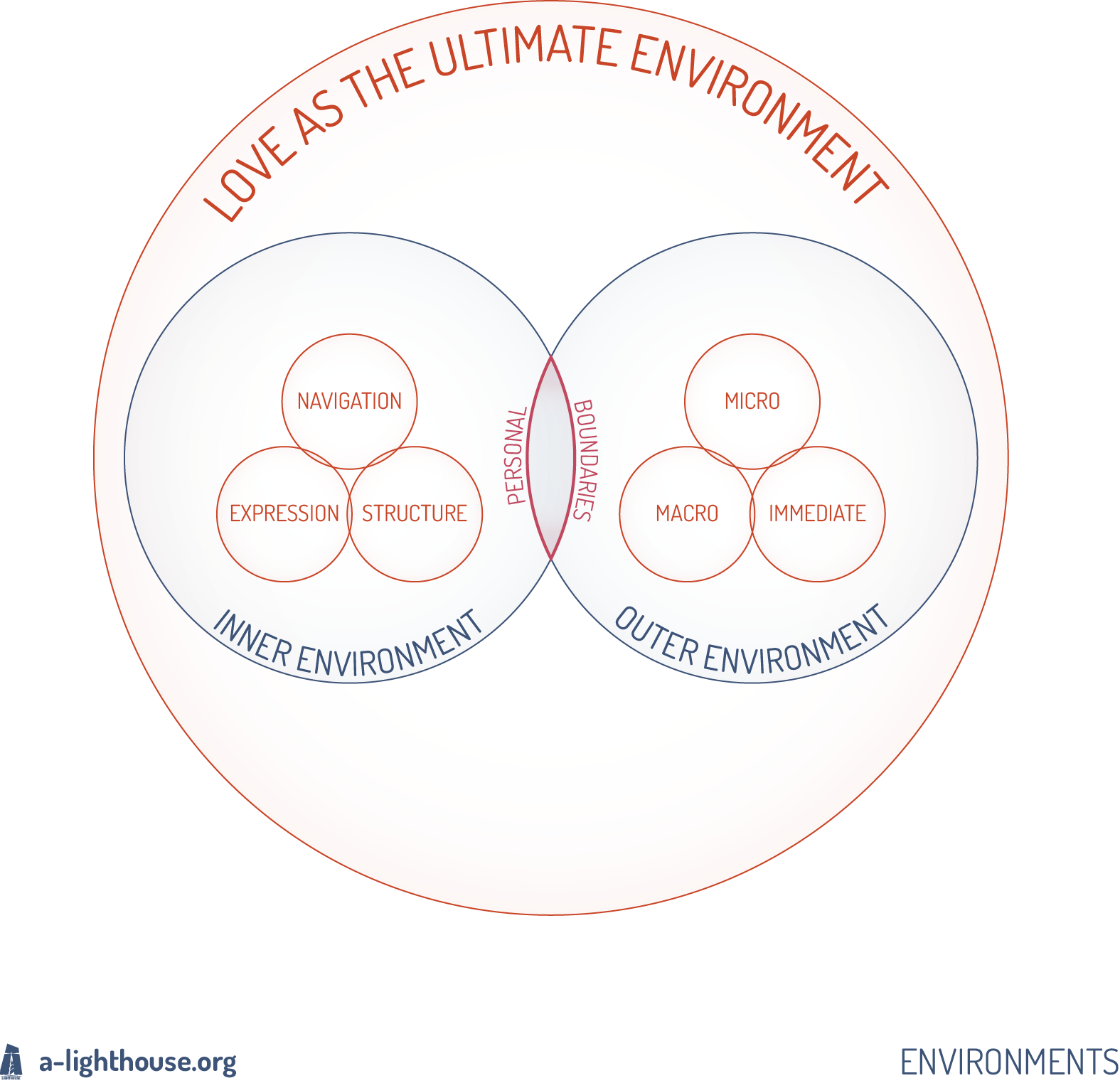
Love as the Ultimate Environment


Inner Environment


Personal boundaries are what protect the inner environment from the outer environment. That is coming up in the Self-love section of the program. Itโ€™s in development!


Outer Environment


BREAKOUT!

>>>

1.3 Conclusion

You are never separated from love, even if you feel that you are. You cannot see the air, yet itโ€™s there. Love knows and supports you, but it pushes you to grow in ways that unite rather than divide. When the time for survival mode reaches its end, love is ready and waiting to receive you.

ย We have separated the environments in your life so that we establish how you fit into the scale of the universe. This breaks things into smaller, manageable pieces, and itโ€™s okay to feel small or big at times. Consider this: there are many big or small things you could be worrying about, but you arenโ€™t, yet life continues.

Activities

Micro Actions


2. Who am I?

Ask this because
  1. It reveals your uniqueness, not through vanity or humility, but as a service to love.
  2. It reveals your principles.
  3. It helps you know what to believe by trading indoctrination for intuition.
  4. It shows that your actions matter.
  5. It shows how to value yourself.
  6. It shows your identity across your life.
  7. It helps you know what you want and set goals.
  8. It unveils your locus of control (how you seek validation) by distinguishing the relative self from the absolute self.

2.1 Validation

Cleanembed

A person stands between an internal and external world. We can picture these relationships by looking at an illustration called the Self-identity Diagram.

BREAKOUT!

>>>

For Youngsters and the Sheltered

If you are a young person, knowing who you are can start any time you are ready to ask these questions.

Whether you are young or you donโ€™t have much experience with life, existence can become a drag. Thatโ€™s because you have grown comfortable with the status quo; youโ€™ve hit a happy medium. When you start thinking of getting out there in life, you remember the pain it causes. This is the Emotional Avoidance Trap in effect!

Therefore, you avoid activity because it feels like moving is dangerous, but this mindset is like being in quicksand. If you donโ€™t move, eventually you will just sink.

The existential questions asked regarding self-identity are heavy. Sometimes, the reality is that it takes time and experiences to discover the answers for yourself. Before your self-identity is realized, itโ€™s a good idea to involve yourself in various activities.

You donโ€™t have to know who you are before you interact with the world. Thinking tirelessly of who you are can be an endless loop if you have no understanding on whatโ€™s possible in the world.

Therefore, experience the world, set a goal, and explore. Toss some ideas against the wall and see what sticks. Try stuff you never tried before. Travel to a new culture if you can. Doing so can open up many new perspectives and give you great clues as to what you prefer, which may lead to refining and revealing who you are.

No matter what you do, the experiences you have will teach you something. The more experiences you have, the better the chance you will find something meaningful to you.

2.2 Six-String Guitar

In the program, your self-identity is composed of 6 important aspects, and we use a six-string guitar to illustrate the understanding of how these aspects work together. Each of the below aspects, or strings, are explained later.

Cleanembed


Breakout!

>>>

Locus of Control

Remember, the locus of control describes how you seek validation, from the external or internal world. Itโ€™s called the locus of โ€œcontrolโ€ because it gives control over your mental state to the internal world (you) or the external worlds (other people and events).

How to Find Your Locus of Control
Finding what validates you is important because validation gives us the energy to keep going. Think about moving through a room, but no one looks at or engages you. Depending on your locus of control, you could feel fine or like a ghost.


Absolute vs. Relative Self Chart

Cleanembed

You can use this chart to see what makes you feel validated. Write it down so that itโ€™s easier to remember. Most people will feel a mixture of both internal and external validation, but try to choose the dominate one.

Click Absolute vs. Relative Self if you want to know more about this.

2.3 Conclusion

You are a vast, complex, and almost undefinable human being, but just like any other subject, you are knowable. There are so many aspects to who you are; it might be impossible to know all of them, but you can at least try to know some. The fact is the more you know yourself, the more you understand yourself, and the easier you can give yourself the gift of your personal power.

You matter because we need you, only most of us donโ€™t know it.

Activities

Micro Actions


3. What do I want?

Ask this because
  1. It reveals what you truly want and encourages to realize your dream, not the social one.
  2. It teaches that true desire is active, creative, and full of challenges.
  3. It shows the difference between escapism and productivity.
  4. It uncovers the traps that will slow your pace and the states that define it.

3.1 Desire

If you understand what desire is, it becomes easier to find it.

Definition of Desire


Cleanembed

Traps and States

What happens next? Either you are strong enough to know and accept the risks, or you fall into Traps or States, for better or worse.

3.2 Conclusion

Learning what you desire is the third step. You first must learn how to desire. To learn how to desire, you must do one of two things (both at the same time is good): experience the world by taking agency and by knowing who you are so that you can gift yourself with something appropriate.

Itโ€™s like buying a gift for someone that you donโ€™t know: you donโ€™t know where to start, so you go the safe route and buy something practical. This is safe, but it doesnโ€™t always work.

Activities

Micro Actions


Conclusion

By now, you may see a pattern developing: be human, be you, and involve yourself in the world. Everyone has their own reality; they wish for it to be real, but reality only reflects what happens, not dreams. When we try, we are met with friction: the stress of effort, the sting of failure, and the drain of disappointment. We see those as mistakes that set us back, but they are the steps that teach. We learn what is best for us, what doesnโ€™t fit us, and we grow from that.

Human Tree Analogy


See Also

โœฆ

Invisiblock

Environments are what are inside of us and around us. They help shape our world both inside and outside of us.

Science informs us that an organism or an object can never be removed from the environment. No matter where it is, it exists within some kind of environment, whether thatโ€™s an ocean or the surface of a distant moon.

In this program, environment is understood in these ways.

Order of Environments

Invisiblock

center

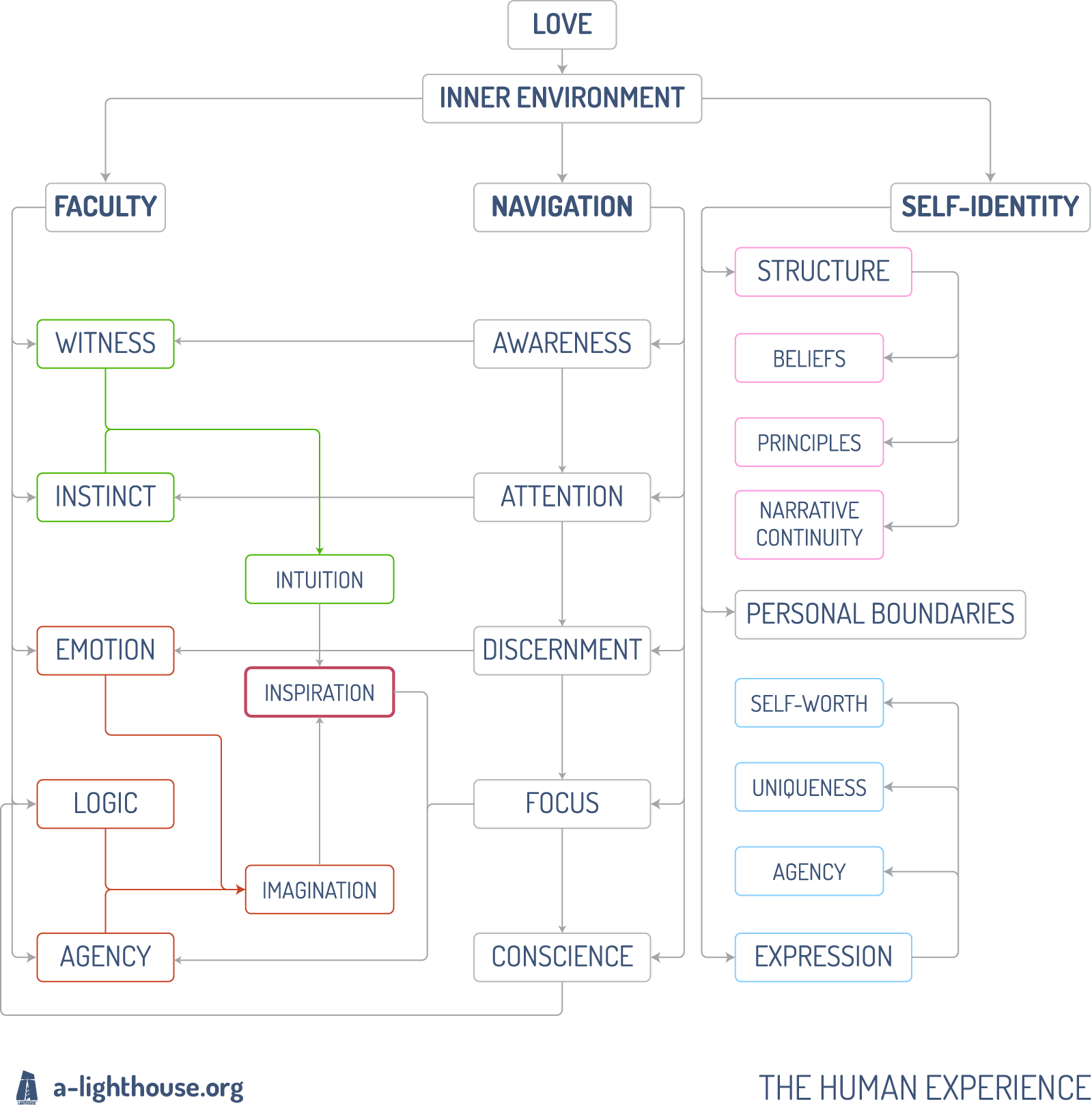
The Human Experience

Cleanembed

Invisiblock

This is about how humans experience life. You have so many tools to help you be yourself, accomplish goals, and find safety.

The inner environment, that space in your mind, contains all the tools, and we describe them in the Faculty and Navigation groups.

  1. Love
    1. Inner World
      1. Faculty
        1. Instinct > Intuition
        2. Emotion > Imagination
        3. Logic > Imagination
        4. Witness > Intuition
        5. Agent > Imagination
      2. Observation Deck
        1. Awareness > Witness
        2. Attention > Attention
        3. Preference > Emotion
        4. Focus > Agency
        5. Conscience > Logic
      3. Self-identity
        1. Structure
        2. Personal Boundaries
        3. Expression

Micro Environment

The micro (small) environment the smallest in physics. Itโ€™s everything that is much smaller than you can see with your eye. It contains the cells in your body, bacteria, and other really small things. Only things in quantum physics are smaller than the micro environment.

Both the micro and macro environments are the worlds that you saw stretched across the Scale of the Universe presentation. These may not play role in your life that you can immediately notice, but they help to establish the rules of reality.

Immediate Environment

This environment contains everything that is around you that relates to your life. The things in this environment actually affect your life: your country, culture, traditions, family, friends, career, and things going on the Earth itself (like weather, wars, and such). You notice more things in this environment, but you are also blind to some things.

Macro Environment

The macro (big) environment is everything that is much bigger than you. This includes things like planets, stars, galaxies, and so on, not buildings. This is works inside classical physics.


See Also

Love Map

Definition

That which is true in your mind


Also Known As

  • Inner Self
  • Inner/Internal Environment or World

Summary

This inner world is shaped by your mind, which is the collection of your thoughts and emotions. It changes through willpower, experience, and education, and it can be influenced by your physical body and environment.

Itโ€™s a private world only you can sense, and itโ€™s used to help you interact with and understand yourself. It helps you interpret the outer world so that you can survive it.

Think of the inner world as a chaotic dream. While logic is like a detective peering in and trying to make sense of it all, it canโ€™t feel it. The logic interpreting the chaos can structure the dream by organizing it, but it could also be flawed and totally wrong. Therefore, you can use logic to detect patterns, but donโ€™t entirely disconnect from emotions to do so.


Components

Personal Power Traits
These are the 100+ traits that this program outlines. The Personal Power traits are those that a highly efficient person uses to make decisions.

Echo of Elsewhere
This is the feeling that you forgot something about a different reality, as if there is a big hole in your spirit. Not everyone feels the Anamnesis to the same degree.

Faculty
This is a toolset of natural abilities that come with being a human in the world. You use the Faculty to experience life and your environment. These will help you find your personal power.

Picnic Baskets
These tools are called โ€œBehavior Setsโ€ (or simply โ€œbasketsโ€) because each group cherry picks specific personal power traits, just like a picnic basket would have a variety of foods.

For example, the Defense Basket holds all the tools needed to protect you, such as rationalization, lying, and deflections.

Inner Observatory
This is how you make observations. The Vantages includes the Observation Deck (or Subjective Consciousness) and the Telescope (Objective Consciousness). Since subjectivity is a lower skill than objectivity, everyone starts at the first step of this tool.

Psychological Friction
Generated by the difference between your expectations and what actually happens,ย Frictionย is the struggle that naturally happens between the private and shared realities.


See Also

Direct Connections

Indirect Connections

Love Map

Definition

The material reality that is observed and agreed upon by a group


Also Known As

  • Outer Environment or World
  • Real World

Summary

This is the world you inhabit together with other people, objects, and placesโ€”from vast galaxies to small atoms. It is the outer landscape of physical facts, places, and events that multiple observers can experience.

This is shaped by time, space, and physics, and it is constantly changed by the Feedback Loop.

The shared reality is both the classroom and the teacher, but it is neutral to your success: it neither favors nor despises anyone. However, the systems behind it retain nearly full control of what happens to you physically and, in some cases, mentally.


Components

Environments
This is a general term for specific areas, called Environments, within Dimensional Reality. These are the spaces in which everything outside of your mind exists, and they are the containers for the rules of the environment. For example, in our universe, there are rules for space, time, and physics. Environments include all dimensions whether or not human beings can detect them.

Within Environments is the Feedback Loop that consists of the details of the environment. In our world, the details include limitations, actions/events, and consequences. The Feedback Loop contributes to Psychological Friction, or simply โ€œfriction.โ€

Psychological Friction
Generated by the difference between your expectations and what actually happens, Friction is the struggle that naturally happens between the private and shared realities.


See Also

Direct Connections

Indirect Connections

Immediate

Micro/Macro

Awareness

Conscience

Invisiblock

Principle 1:
The Ultimate Environment

Love is the ultimate, all-accepting environment from which you will never be removed. It is not a passive emotion.

This program is centered upon love as the ultimate environment because love accepts everything and rejects nothing. Itโ€™s the space in which both the light and the dark parts of human experience are allowed to exist without judgment. Every experience is valid.

We are humans living human experiences. We must not look to escape the darkness or bypass hardships; we must face our darkness in the shade of our light. This means we must use our personal power to stand strong, learn, and grow. We must not run away, suppress, or hide. Since love accepts all, every failure is a step forward.


Moral

You can never be unloved.


Mnemonic

Love accepts me.


Goal

Understand that you are always in the environment of love, and you can never be separated.


Learning Points

  1. The Ultimate Environment
  2. Diagram Explanation

Announote

The journey starts with love because, with it, anything is possible.


1. Ultimate Environment

Invisiblock

Biggest Environment
Love is the biggest environment because everything exists within itโ€”good and evil. It penetrates and creates everything, and it prefers unity over division. Your behaviors may be misaligned with loveโ€™s preference, yet you always exist within it, whether or not you realize it.

Acceptance
Love is the all-accepting, inclusive environment because it does not reject, judge, or abandon. You will never be separated from love because it accepts you. If you feel like you are lagging behind, love waits for you to catch up. Love appreciates you; it understands who you are. It exists even for individuals who cause harm because it acts as their chance for redemption. Without love, there would be no hope.

Possession
You neednโ€™t earn love because you already have it. Unity binds people together, and it prefers progress toward that rather than toward division. Love wants what is best for you, and those who prefer evil deeds may need such deeds to grow toward good. At times, it may seem that you are removed from love, yet you are not. Your mindset might be blinding you because of traumas. Resultantly, love may be buried underneath your traumas, yet it waits patiently for you to remove the blindfold and dig it up.

Never Removed
Science claims that an organism or an object cannot be removed from an environment. Wherever it is, it exists within an environment, whether thatโ€™s in the vacuum of space or in a local lake. Since this program claims that love is an environment that contains all other environments, you cannot be separated from love.

No Mistakes
Life is limitations, choices, consequences, and adaptations. No matter which choice you make, there are consequences. You make the best choices you know how to avoid the worst consequences, and you learn from the results. Looking at it that way, the mistakes you make are not mistakes, but exactly what you need to progress to the next part of your life.


2. Diagram Explanation

Captionator

full

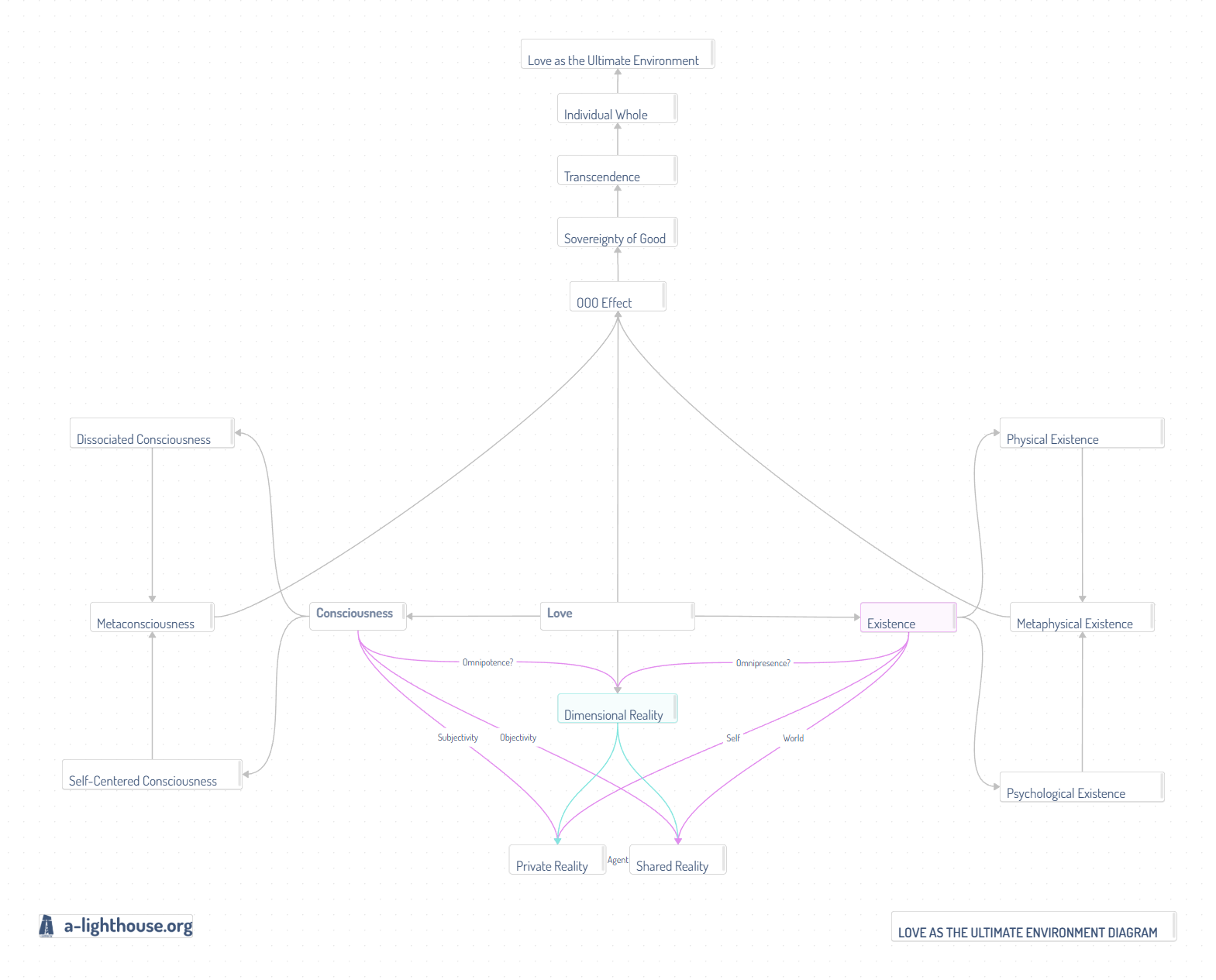
This diagram starts mapping the understanding of love. Click to expand!
Step 1
For this diagram, letโ€™s use your imagination for a second. Imagine a totally empty space; not even โ€œnothingโ€ exists. Itโ€™s emptier than empty because the space hasnโ€™t been defined. However, it has the potential to be everything. All it needs to do is become aware of itself.

Step 2
When the empty space looks inward, it becomes more defined. It becomes the Ultimate Environment. It becomes love itself, and itโ€™s the spark it needed to find its own โ€œpersonal power.โ€ The Ultimate Environment can use this unlimited, all-mighty power to create anything it wishes. Suddenly, everything the it ever thought of bursts out in an instant fire of creation, and the flame dies just as quickly.

Step 3
Now, letโ€™s look at the diagram. What you see here shows love, the Ultimate Environment, in the center. To prevent you from feeling overwhelmed, the chart doesnโ€™t display everything that love ever made in step 2 above. Instead, the diagram shows the most important things that love creates. Everything is created simultaneously.

Connections

  1. Consciousness: the ability to sense
  2. Existence: the ability to be
  3. Dimensional Reality: the place to be

At this moment, everything has the ability to sense, be, and a place to live. You are included in this moment in the diagram, and this is perhaps the highest form of existence. Here, you might be omniscient, omnipresent, and more.

Step 4: The Fractured Mirror Analogy


Conclusion

Love is the beginning and the end, the full circle of consciousness, existence, and environments. It composes the stars in the universe just as easily as the cells in your body. You are love, and it is never distant.


See Also

Direct Connections

Indirect Connections

โœฆ

Instinct Emotion Logic Witness Agent